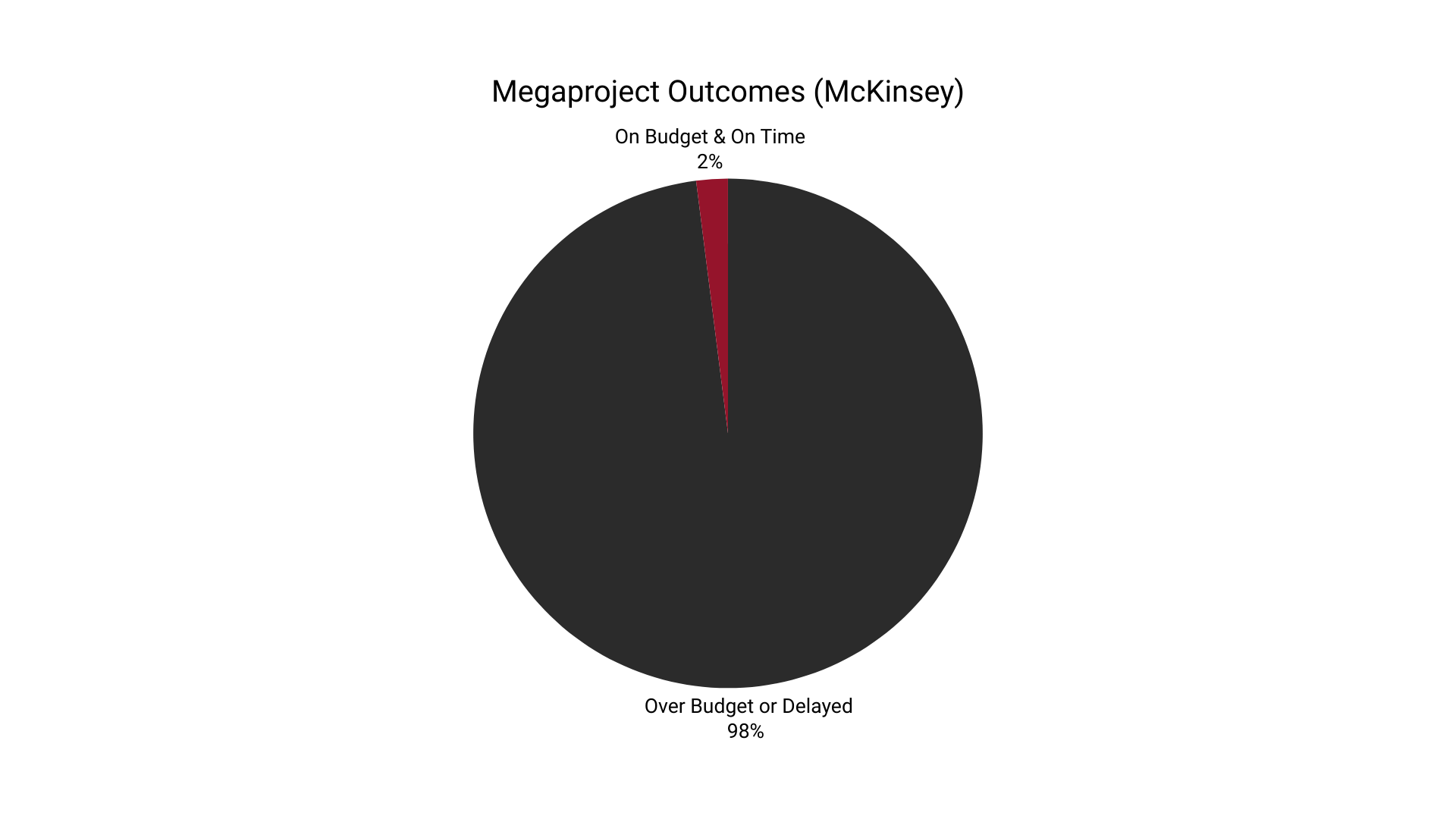
Construction is one of the most capital-intensive industries in the world. Yet despite the money, talent, and effort poured into projects, failures are remarkably common. McKinsey has reported that 98 percent of megaprojects face cost overruns or delays, with average overruns of 80 percent and average slippage of 20 months. Oxford professor Bent Flyvbjerg’s work confirms that nine out of ten large projects blow their budgets, often by 50 percent or more.
If you have ever wondered why, the answer is surprisingly simple: most projects are losing before they even begin.
The culprit? Weak or rushed pre-construction.
The Hidden Cost of Skipping Pre-Construction
When pre-construction is treated as a box to check instead of the foundation of the project, owners and teams pay the price:

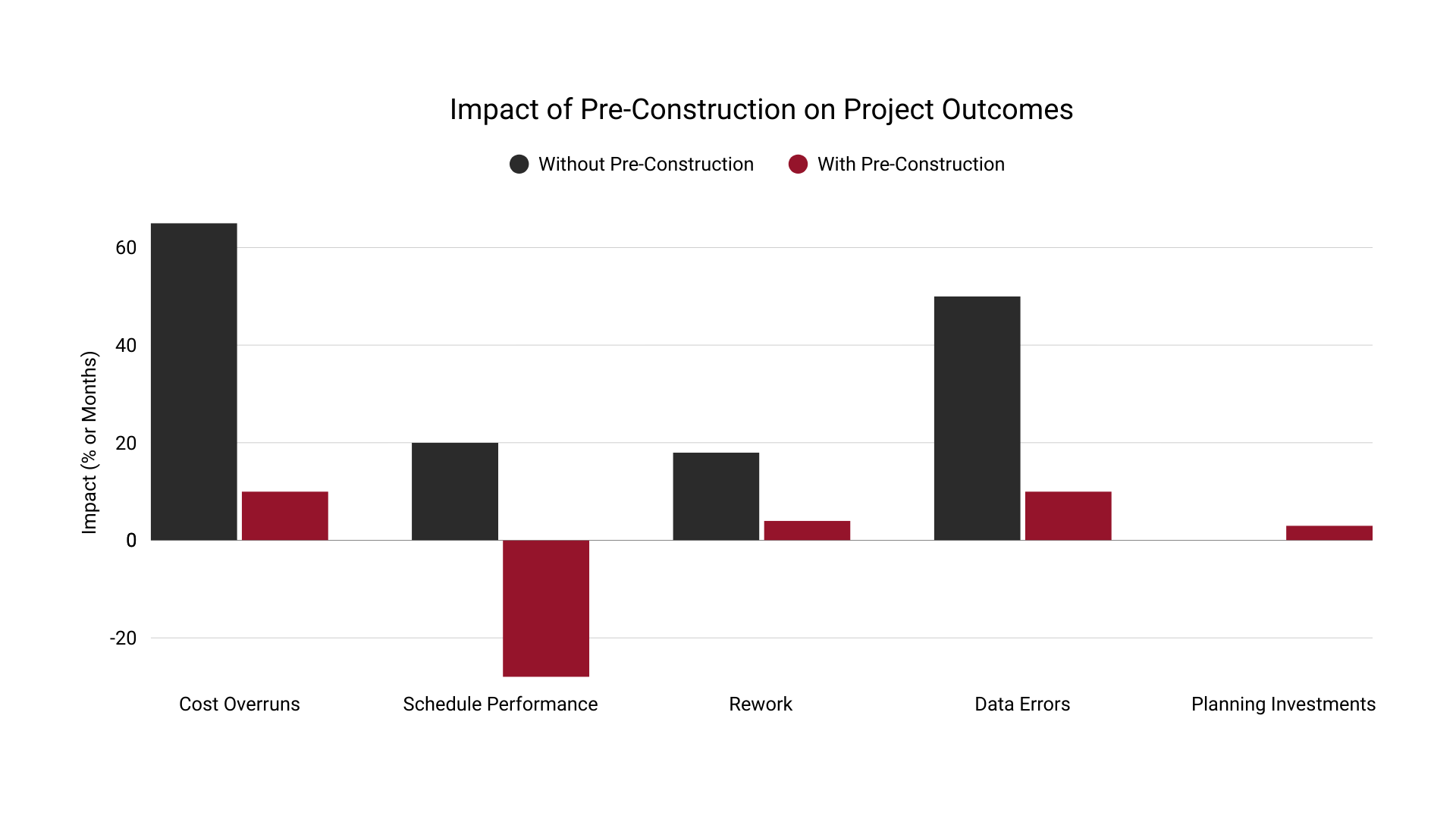
- Rework: FMI research shows that rework accounts for about 19 percent of total project cost, and only about 30 percent of that can be recovered. That means millions are lost before a building is even complete.
- Communication Breakdowns: PlanGrid and FMI found that nearly half of the rework is caused by miscommunication and poor project data. If scope and expectations are not clearly defined early, mistakes multiply exponentially.
- Bad Data: According to Autodesk and FMI, poor data quality contributed to $1.8 trillion in global construction losses in a single year, including $88 billion in avoidable rework.
- Productivity Drag: Construction productivity has lagged other industries for decades. Without robust planning, the problem compounds as costs rise faster than inflation.
These failures aren’t abstract statistics; they show up in very real ways: frustrated owners, drained contingency budgets, delayed openings, finger-pointing among contractors, and projects that feel more like battles than builds.
The Value of Pre-Construction
Here’s the good news: there is a clear, research-backed solution. Pre-construction is not just planning. It is the disciplined, structured process of aligning vision, scope, budget, and execution strategies before the project’s ground-breaking.
The Construction Industry Institute (CII) calls front-end planning the single most valuable process in the capital project life cycle. Their research demonstrates:
- Projects with mature front-end planning reduce total cost by up to 20 percent.
- Owners who invest in pre-construction cut schedules by up to 39 percent.
- Organizations applying best practices in pre-project planning see average savings of 7 percent across their portfolios.
In other words, when you invest just 2 to 4 percent of project cost in pre-construction, you routinely save 5 to 20 percent downstream.
That’s a return any CFO would be proud of.
Pre-Construction is the Engine Behind Every Successful Build
Think of pre-construction as preventive medicine for projects. Just as catching an illness early is far less painful and costly than treating it in crisis, proactive planning identifies risks, clarifies scope, and establishes accountability before problems metastasize.
Some of the key benefits include:
Creating Clarity of Scope: Many overruns are created by unclear or constantly shifting project scopes. Pre-construction asks the difficult questions early: What are the must-haves vs nice-to-haves? How will we handle design changes? Who makes final decisions?
Stakeholders Are Aligned: Owners, designers, contractors, and consultants often bring different assumptions to the table. During pre-construction, teams surface assumptions and build alignment. Thus reducing disputes later.
Owners Gain Dependable Cost and Schedule Forecasts: Tools like the Project Definition Rating Index (PDRI) provide measurable benchmarks for scope maturity. The U.S. Department of Energy even mandates readiness checks before performance baselines to reduce cost and schedule risk.
Minimized Rework and Change Orders: Proactively addressing issues related to constructability, sequencing, and procurement ahead of time enables teams to avoid the unexpected mid-project challenges that often result in expensive change orders.
Effective Risk Mitigation: While pre-construction cannot eliminate risk, it does reduce it. When owners are empowered early through proactive planning, they make stronger decisions than they ever could in the heat of a mid-build reaction.
The ROI in Action

$35 Million Luxury Residential Project
- Invests 2% ($700,000) in pre-construction
- Prevents 10% ($3,500,000) in downstream overruns
Downstream Savings = $2,800,000

$5 Million Luxury Home Renovation
- Invests 3% in pre-construction = $150,000
- Prevents 10% in downstream overruns = $500,000
Downstream Savings = $350,000

$78 Million Luxury Residential Project
- Invests 2.5% in pre-construction = $1,950,000
- Prevents 10% in downstream overruns = $7,800,000
Downstream Savings = $5,850,000
In all cases, the math is undeniable: planning pays.
The False Economy Pitfall
Some owners hesitate at the additional upfront cost of pre-construction services. It can feel like paying for “work before the work.” But this is a classic false economy. Skip the two percent investment, and the project will charge you twenty percent more in the downstream of the project.
As one CII study put it, “Every dollar spent in front-end planning saves four to six dollars in execution.”
Skipping pre-construction is not saving. It is gambling.
Case in Point: Vacation and Second Homes
Consider second or vacation homes. These projects often involve owners who live hundreds or thousands of miles away. The complexity of distance, multiple residences, and seasonal demands makes a strong pre-construction non-negotiable.
Without it, approvals get delayed, communication falters, and quality control suffers. With it, owners receive regular site updates, video walkthroughs, and coordinated team alignment—all of which protect the investment and the peace of mind that a second home should provide.
Building with Confidence
The construction industry has a reputation problem because too many projects fail to deliver on time and on budget. But this reputation is not inevitable—it is the direct result of underinvesting in pre-construction.
When owners, developers, and investors commit to robust pre-construction analysis, they:
- Gain confidence in their budgets and schedules.
- Strengthen collaboration among all parties.
- Reduce the odds of disputes and litigation.
- Achieve projects that meet both vision and financial expectations.
In short, when faced with the choice of planning or paying, the smart money always plans.
References
- McKinsey & Company. The Construction Productivity Imperative. Reports that 98% of megaprojects face cost overruns or delays, with average cost growth of ~80% and average schedule slippage of 20 months. Read report
- FMI. State of Global Preconstruction Report. Finds that rework accounts for about 19% of total project cost, with only ~30% of that cost ever recovered.
- Autodesk & FMI. Construction Disconnected Report. Shows that nearly half (48%) of all rework on U.S. jobsites is caused by miscommunication and poor project data. Read summary
- Autodesk & FMI. The Impact of Bad Data on Construction. Estimates poor data contributed to $1.8 trillion in global construction losses in a single year, including $88 billion in avoidable rework. Read article
Enjoying this content? Subscribe to our newsletter.
ADVOCATE – Residential Construction Advisors is your trusted partner from concept to completion. With decades of experience in high-end residential construction and a nationwide network of experts, we represent homeowners and future homeowners with integrity, precision, and purpose.
Whether you are breaking ground on your dream home, navigating a dispute, or turning around a complex project, our role is straightforward. We protect your investment and bring your vision to life on time, on budget, and without unnecessary conflict.
When we are not on site or in strategy sessions, you might find us walking a job site at sunrise, blueprint in one hand and coffee in the other. The best builds begin with clarity, communication, and care.
Connect with us today to discover how ADVOCATE-RCA can help protect your vision and bring your luxury home to life.